
Benefits of Wood Decks: Why Natural Wood Remains One of the Best Choices for Wisconsin Homeowners
Updated: Jul 28

When homeowners begin planning a new deck, the conversation often turns to composite decking. Composite products have become increasingly popular because of their low-maintenance requirements and long warranties. However, despite the growth of composite materials, the benefits of wood decks continue to make them one of the most practical, attractive, and enduring decking options available.
For homeowners throughout Wisconsin, wood decking offers advantages that extend far beyond simple cost comparisons. From cooler surface temperatures and natural beauty to repairability and long-term versatility, a natural wood deck provides benefits that many homeowners find difficult to replicate with manufactured materials.
The best deck material is not always the one that requires the least maintenance. Sometimes the best choice is the one that provides the most enjoyment, the greatest design flexibility, and the strongest connection to the home itself.
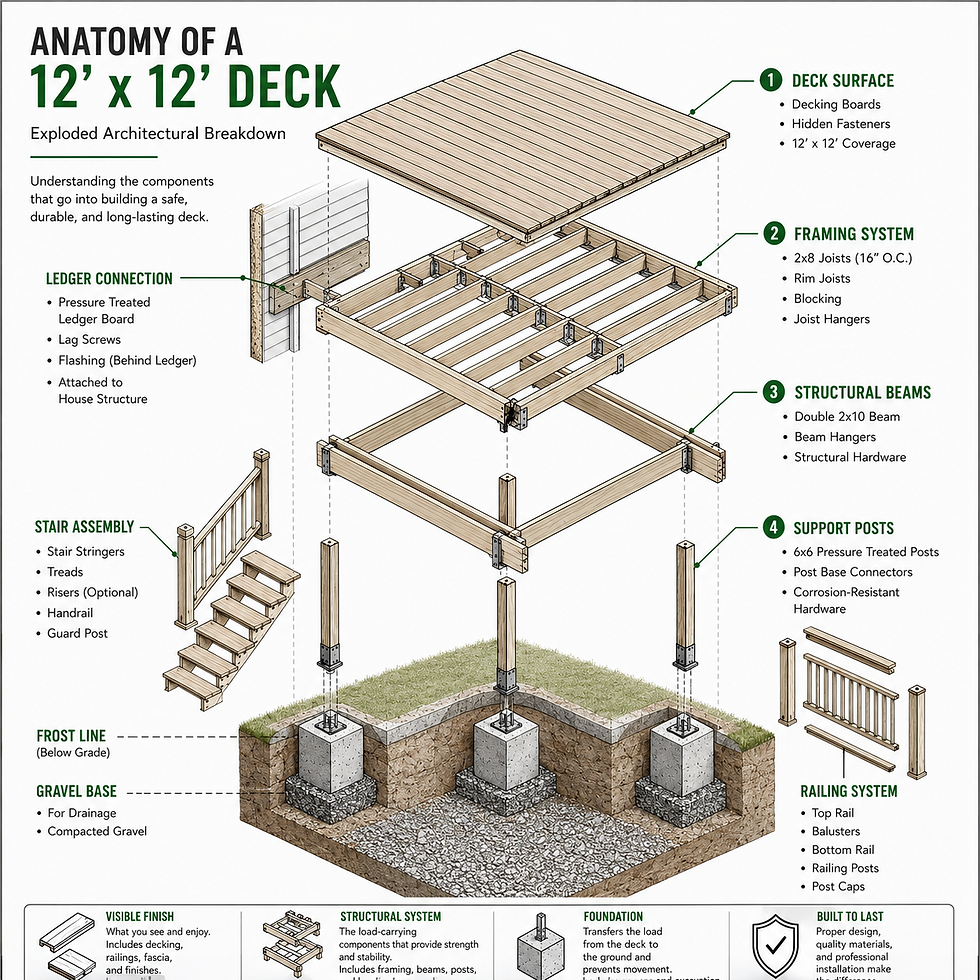
Wood decking also remains one of the most accessible options for homeowners planning a new outdoor living space. While costs vary based on design, site conditions, and materials, a professionally built 12x12 pressure treated wood deck in Wisconsin often falls between $11,000 and $13,000. Homeowners interested in a deeper breakdown of labor, materials, permits, and design considerations can explore deck construction costs in Wisconsin. This combination of affordability, customization, and long-term durability continues to make wood one of the most popular decking materials available.
Wood Decks Stay Cooler During Summer
One of the most overlooked benefits of wood decks is comfort during warm weather. Many composite decking products absorb and retain significant amounts of heat when exposed to direct sunlight. During Wisconsin summers, darker composite deck boards can become noticeably hot under bare feet. While newer composite products have improved in this area, natural wood generally remains cooler to the touch.
This makes wood decks particularly appealing for families with children, homeowners who enjoy walking barefoot, and anyone who spends long periods enjoying their outdoor living space during the summer months. A deck should be comfortable to use throughout the season, and surface temperature plays a larger role in comfort than many homeowners initially realize.
Why Wood Decks Offer More Design Flexibility Than Many Decking Materials
Wood offers a level of design flexibility that is difficult to match.
Because it can be cut, shaped, routed, sanded, stained, and finished in countless ways, wood allows builders to create custom details that would be difficult or impossible with manufactured decking materials.
Decorative post details, custom railings, curved elements, exposed craftsmanship, intricate stair designs, and architectural accents are often easier to achieve with wood. Homeowners who want a deck that complements the character of their home often appreciate the creative freedom that wood provides. For homeowners who value individuality and craftsmanship, wood creates opportunities for customization that go far beyond the deck boards themselves.
Practicality matters, but outdoor living spaces are also meant to be enjoyed. A deck is often one of the most visible and frequently used features of a home, making aesthetics an important part of the decision-making process.
The Natural Beauty of Wood Decking

Composite decking manufacturers have made significant advances in replicating wood grain patterns and textures. However, many homeowners still prefer the appearance of genuine wood. Natural wood contains variation, texture, character, and warmth that cannot be perfectly reproduced. Every board has its own grain pattern. Every deck develops its own personality over time.
Wood also allows homeowners to completely transform the appearance of a deck through staining and finishing. Colors can be updated, refreshed, or changed entirely as design preferences evolve. This flexibility can be especially valuable for homeowners considering future renovations or outdoor living upgrades and deck design improvements. Composite decking generally locks homeowners into a specific appearance for the life of the material. Wood provides flexibility.
Wood Feels More Authentic
There is also an experiential difference. Wood sounds different underfoot.
Wood feels different. Wood smells different. Many homeowners describe natural wood as creating a stronger connection between the deck and the outdoor environment.
While composite materials are engineered products, wood remains a natural building material that has been used successfully for centuries. For homeowners seeking authenticity rather than imitation, that distinction matters.
Wood Is Easier to Repair
One of the greatest practical benefits of wood decks is repairability. Individual deck boards can often be replaced quickly and affordably. Minor damage can frequently be repaired without replacing large sections of the deck. Surface scratches can be sanded. Damaged areas can be refinished. Individual components can be removed and reinstalled with relative ease.
This flexibility can be especially valuable as a deck ages. Homeowners evaluating wood deck maintenance, long-term deck ownership costs, and how to extend the life of a wood deck often discover that maintaining a wood deck is more straightforward than they initially expected. With composite decking, matching replacement boards years later can sometimes be difficult if manufacturers discontinue colors or product lines. Wood offers flexibility when repairs become necessary.
Easier Modifications in the Future
Homes evolve. Families grow. Outdoor spaces change. A deck that works perfectly today may need modifications years down the road. Wood makes these changes easier. Whether adding a pergola, expanding the deck, adjusting railings, modifying stairs, or integrating new outdoor features, wood structures can often be altered more easily than composite systems. This adaptability can significantly extend the usefulness of the deck over time and make future improvements more practical.
How Long Do Wood Decks Last?
One of the most common misconceptions is that composite decking automatically lasts longer than wood. The reality is more nuanced. An improperly maintained wood deck may deteriorate prematurely. However, a properly built and properly maintained wood deck can provide service for many decades. Routine staining, sealing, inspections, and occasional board replacement can dramatically extend the life of a wood deck.
In some cases, a well-maintained wood deck can outlast certain composite systems whose surface materials eventually fade, crack, or become outdated. Longevity depends not only on the material itself but also on maintenance, installation quality, and environmental conditions. This is especially true in Wisconsin, where seasonal moisture, snow, and freeze-thaw cycles test every exterior building material.
Many homeowners researching wood decks versus composite decking eventually discover that longevity is only one part of the equation. While composite products may reduce maintenance requirements, wood continues to offer advantages in appearance, customization, comfort underfoot, repairability, and overall character. The best choice depends on the homeowner's priorities, but wood remains a strong option for those who value craftsmanship and authenticity.
The Structure Is Usually Wood Anyway
Another point that is often overlooked is that most deck structures are built from wood regardless of the decking material selected. Joists, beams, posts, blocking, stair framing, and many structural components are commonly constructed from treated lumber. Even when composite decking is installed, the deck's structural skeleton is frequently wood. This raises an interesting question: If the entire structure supporting the deck is already made of wood, why not use wood for the walking surface as well? For many homeowners, the answer is simple. Wood provides consistency, aesthetics, affordability, and proven performance.
Some Things Are Worth Taking Care Of
One of the strongest arguments in favor of wood decking is philosophical rather than technical. Modern products are often marketed around the idea of eliminating maintenance entirely. While convenience certainly has value, not everything worthwhile is maintenance free. Homes requires maintenance. Landscaping requires maintenance. Gardens require maintenance. Wood decks require maintenance as well. Many home-owners view that maintenance not as a burden but as part of caring for something valuable. The reward is a deck with natural beauty, authentic character, design flexibility, and long-term performance. Sometimes the things worth having are also the things worth taking care of.
Why Wood Decks Continue to Be a Smart Choice
The benefits of wood decks continue to make them one of the most compelling decking options available to homeowners. They stay cooler during summer months, offer exceptional design flexibility, provide natural beauty, simplify repairs, and allow for future modifications that may be difficult with other materials. When properly built and maintained, a wood deck can provide decades of enjoyment while creating an outdoor living space that feels authentic, welcoming, and uniquely connected to the home.
For Wisconsin homeowners evaluating decking materials, wood remains a practical, beautiful, and enduring investment that continues to stand the test of time. Whether comparing wood decking to composite materials, evaluating deck construction costs, or exploring long-term deck maintenance, homeowners often find that wood continues to offer a balance of authenticity, flexibility, and value that is difficult to replicate.


Comments